Hand-beaten slabs
The wooden beater leaves a rhythm no machine can reproduce.
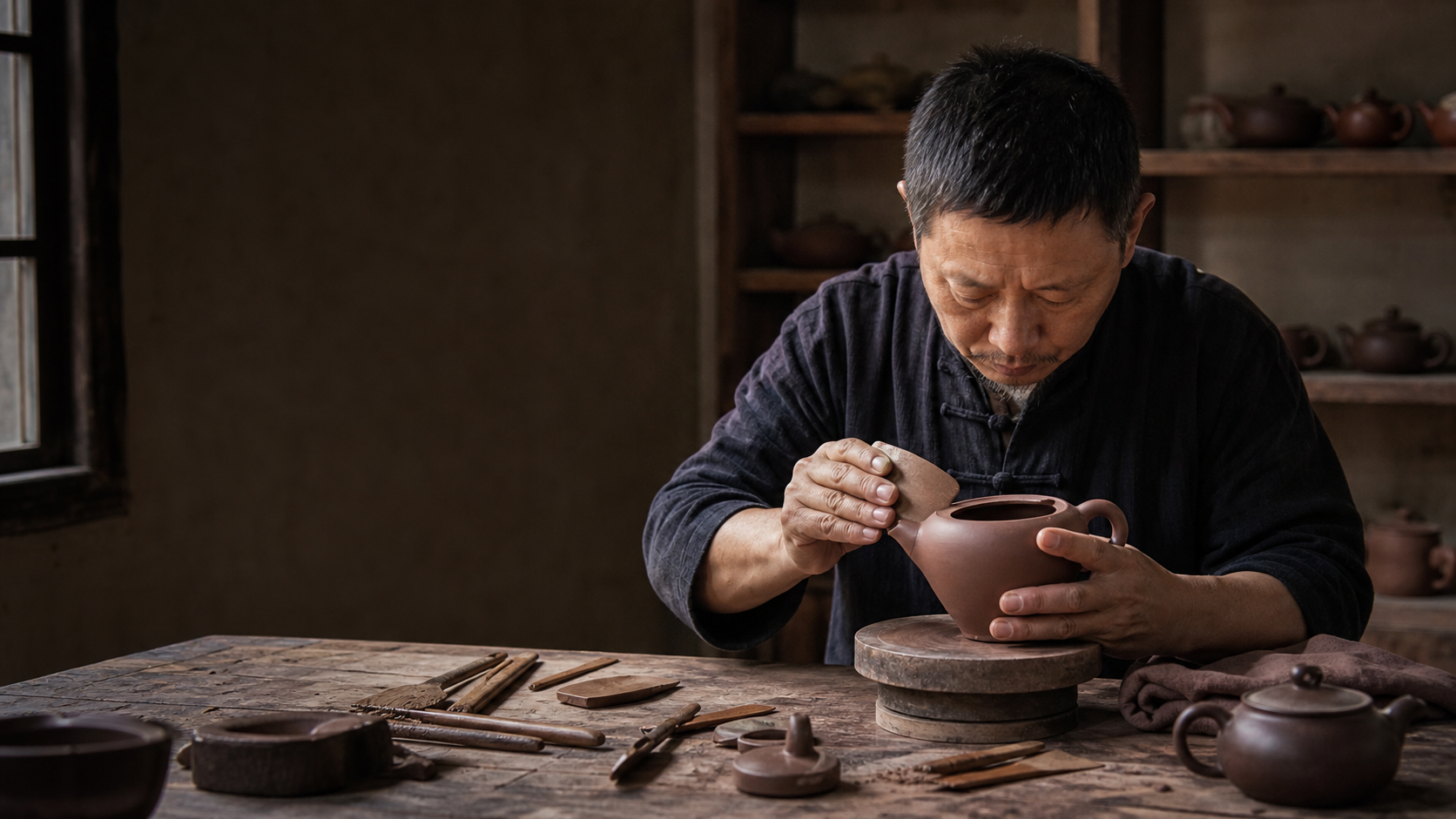
THE HEART OF THE CRAFT
The distinctive structure of Yixing Zisha is preserved through patient hand forming. Every stage is completed by an artisan who reads the moisture, tension and response of the clay.
The wooden beater leaves a rhythm no machine can reproduce.
The body is raised and paddled by hand, making every piece individual.
A controlled firing curve allows the clay to reveal its natural color and texture.
Form, lid fit, filling, pouring and finish are checked before a piece is recorded.
THE MAKING PROCESS
Choose a process to read its method and quality checkpoint. Times are workshop references and vary with clay, form and weather.
Clay preparation
Reference time: Varies by clay batch
The clay is selected for the intended form, material character and firing result. Batch and workshop records are checked so the texture and color of the finished teapot begin with a clear source.

Clay preparation
Reference time: Used after full conditioning
The clay is kneaded and rested until moisture and firmness become even throughout. Proper conditioning reduces cracking and uneven movement during hand forming.
Clay preparation
Reference time: About 1–2 hours
A wooden beater turns the clay into even strips and slabs. The rhythm and force of every strike influence particle alignment, plasticity and the character of the formed body.
Clay preparation
Reference time: About 30–60 minutes
Gauges and templates are used to cut slabs for the body and base. Dimensions must be accurate while allowing for paddling and later firing shrinkage.
Body forming
Reference time: About 1–2 hours
The body slab is raised and joined into a cylinder with clay slip. The seam is compressed and refined to create a continuous, stable structure.

Body forming
Reference time: About 3–5 hours
The artisan paddles the cylinder repeatedly, gradually establishing shoulder, belly and foot without relying on a forming mould. This creates the essential profile of an entirely handmade teapot.
Body forming
Reference time: About 1 hour
The base slab is joined precisely to the body. Inner and outer seams are cleaned and reinforced so the teapot stands evenly and remains structurally sound.
Body forming
Reference time: About 2–4 hours
Bamboo ribs with different curves refine the body from inside and out. The artisan controls transitions, symmetry and tension as the rough form becomes precise.
Component making
Reference time: About 2–3 hours
The lid and gallery are made to the exact mouth dimensions. Fit, level and turning feel are checked repeatedly to prepare for a close, usable seal.
Component making
Reference time: About 1–2 hours
The spout is shaped by hand, with attention to its root, line and pouring direction. It affects both the silhouette and the concentration and smoothness of the pour.
Component making
Reference time: About 1–2 hours
The handle is shaped by hand and balanced for clearance, curve and leverage, coordinating visual proportion, grip comfort and the center of gravity of the teapot.
Component making
Reference time: About 2–3 hours
The centerline and height of spout and handle are marked before joining with clay slip. Their three-point alignment is checked to prevent skew and uneven stress.
Refining
Reference time: About 30–60 minutes
Strainer holes are pierced and cleaned according to the form and intended flow. Their spacing and diameter must support both tea filtration and an efficient pour.

Refining
Reference time: About 2–4 hours
Surface, rim, seams, turns and small details are repeatedly compressed and refined with finishing tools. The clay becomes tighter and develops a restrained natural sheen.
Refining
Reference time: About 30–60 minutes
The maker seal, base mark or required carving is applied at the correct moisture stage. Position, depth and clarity must support rather than interrupt the form.
Drying and firing
Reference time: About 3–7 days
The green body dries slowly in a stable environment so every part releases moisture at a similar rate. Drying too quickly can cause uneven shrinkage, cracking or distortion.
Drying and firing
Reference time: About 12–24 hours
Once fully dry, the teapot is loaded and fired on a curve suited to its clay and form. Heating, soaking and cooling are controlled to achieve the intended color and structure.

Inspection and records
Reference time: Completed piece by piece
After firing, every teapot is checked for appearance, lid fit, filling, pouring and airtight behavior. Qualified pieces receive clay, maker and firing records for provenance.
FROM CRAFT TO TEA